
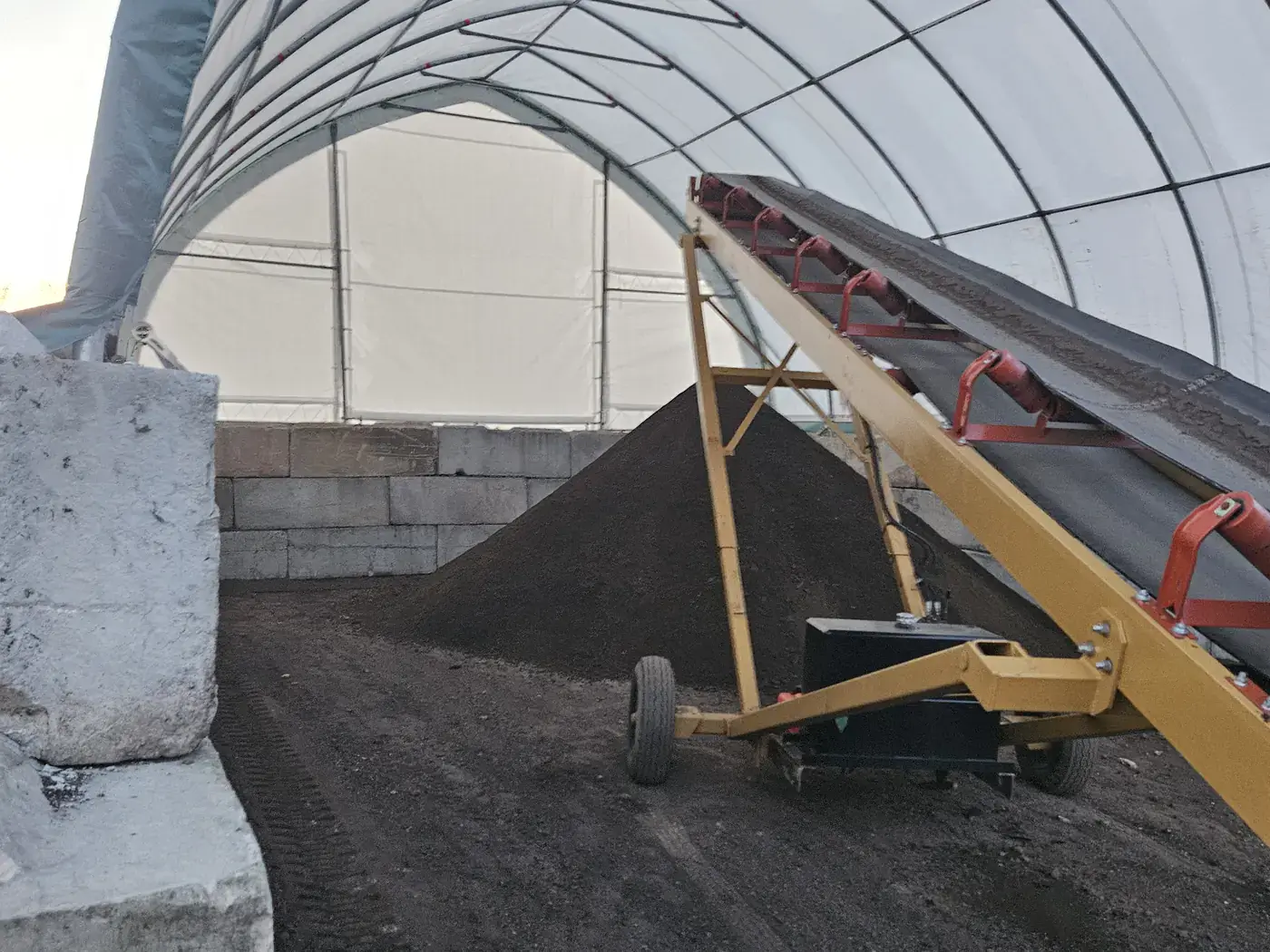
Leaf compost does not turn clay into sand, it changes the way clay particles hold together so water and air can move through instead of sitting on top. Clay in this part of Ohio is heavy, slow to drain and quick to bake hard. Organic matter is the piece that is usually missing. Worked in at the right depth, compost is one of the few things that improves that problem rather than covering it up.
Here's the short version:
- Clay drains poorly because its particles are tiny and pack tightly, leaving very little pore space for water and air.
- Leaf compost improves drainage in heavy clay and moisture retention in sandy soil, which is why the same material fixes two opposite problems.
- Compost is an amendment you mix in. Topsoil is what you build with. They do different jobs.
- One cubic yard covers about 100 square feet at three inches deep, so you can size a load before you order.
- O'Bryan Topsoil and Compost delivers leaf compost in bulk by the cubic yard across Summit County in the warm months.
Why Clay Behaves the Way It Does
Soil texture comes down to particle size. Sand particles are relatively large and irregular, so they stack loosely and leave big gaps between them. Water runs straight through. Clay particles are the opposite. They are extremely small and flat, and they stack like a deck of cards, leaving pore spaces so narrow that water creeps rather than drains.
That is why a heavy clay yard in Northeast Ohio does two frustrating things in the same season. In spring it holds standing water in every low spot and stays greasy underfoot for days after a rain. In August it dries into a cracked surface that a shovel bounces off of. Same soil, same particles, different moisture level. Roots feel the other half of the problem, because they need oxygen in the soil and not just water. When the pore space is tight and full, turf thins out, and foot traffic squeezes what little space was left.
What Compost Actually Changes
Aged leaf compost is organic matter that has already broken down. When you mix it into clay, it does not dilute the clay so much as it changes how the clay assembles itself. Organic matter and soil life encourage fine particles to group together into crumbs instead of lying flat against each other. Those crumbs are larger than individual clay particles, and the gaps between them are larger too.
Larger gaps mean water has somewhere to go. That is the whole mechanism behind the fact that leaf compost improves drainage in heavy clay. It also explains why the same material improves moisture retention in sandy soil. In sand, the organic matter fills and holds. In clay, the structure it builds opens things up. The compost is not doing two different things, it is doing one thing that helps both soils.
Two practical notes follow from this. First, compost works when it is mixed into the soil, not when it sits on top as a blanket. A layer left on the surface of clay mostly feeds the surface and washes toward the low spot. Second, this is a structural change, not an instant one. The improvement shows up as roots, worms and freeze thaw cycles move the material down and through.
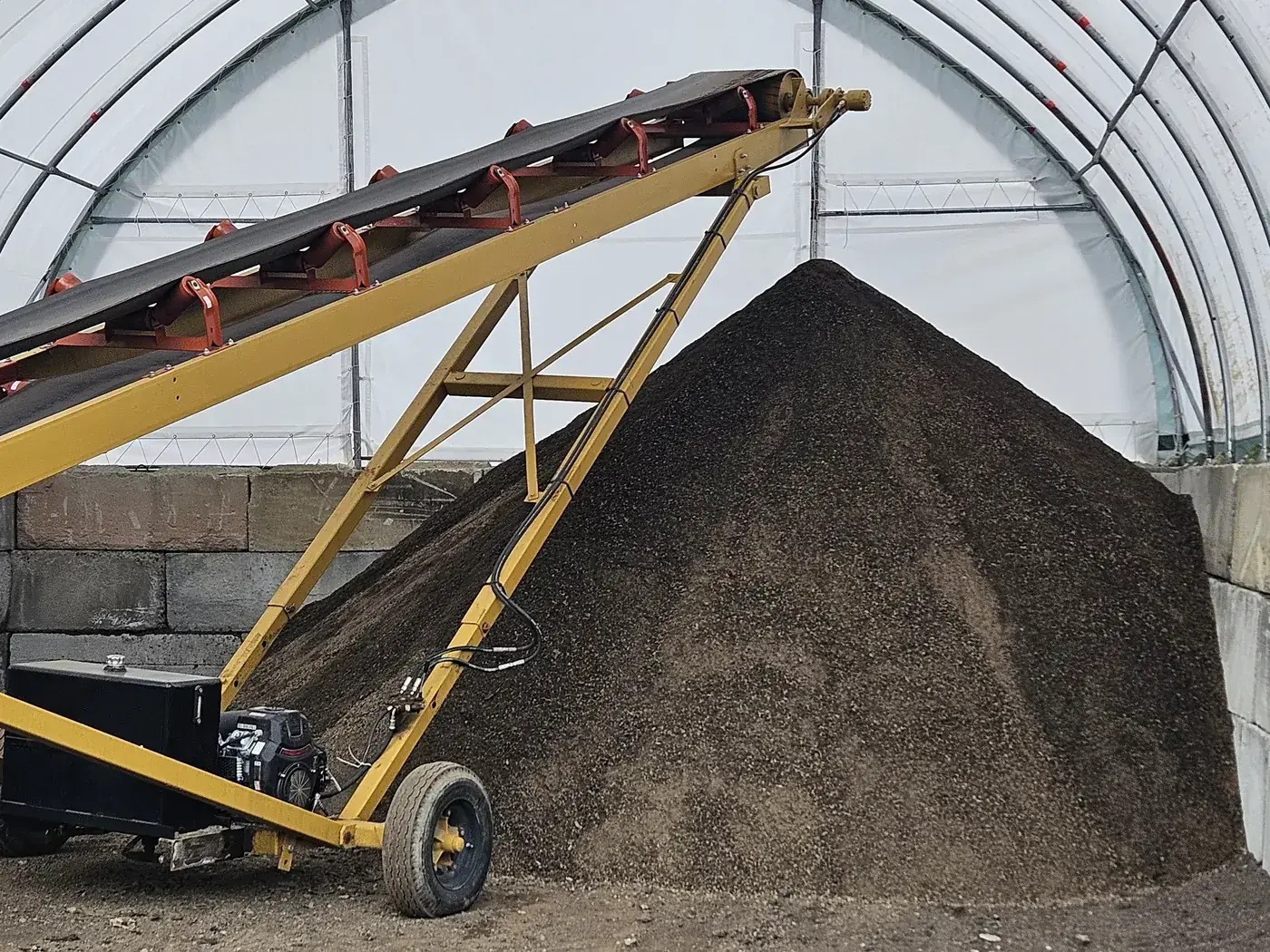
A bulk load of leaf compost dropped at a driveway edge, ready to be spread and worked into the bed.
How Much to Work In, and How to Figure the Yards
Use the coverage rule as your measuring stick. One cubic yard covers about 100 square feet at three inches deep. Divide that out and the same yard spreads roughly 200 square feet at an inch and a half, or roughly 300 square feet at one inch.
For amending clay, most homeowners are working in a layer of an inch or two and then turning it into the top several inches of soil with a tiller, a spade or a garden fork. New beds and vegetable gardens tend to get the deeper end of that range because you can dig them freely. Existing lawns get the lighter end, spread thin enough that the grass blades still show through after you drag it in.
Measure the area first. Length times width in feet gives you square feet, and square feet divided by the coverage figure above gives you cubic yards. If a bed is oddly shaped, break it into rectangles and add them up. Leaf compost is delivered in bulk by the cubic yard, with up to eight yards per load, so a large backyard project does not have to arrive in stages.
Compost or Topsoil, and When You Need Both
The most common mix up is ordering one material when the job calls for the other. This is the simple split.
| Leaf Compost | Screened Topsoil | |
|---|---|---|
| What it is | Organic matter, an amendment you mix in | The material you build soil volume with |
| Main job in clay | Improves drainage and structure | Adds depth, fills and grades |
| Typical use | New beds, gardens, working into tired lawns | Lawns, gardens, grading, filling low spots, new sod |
| Sold as | Bulk by the cubic yard | Bulk by the cubic yard |
| Load size | Up to eight yards per load | Up to five yards per load |
If your yard has a low spot that ponds because the grade is wrong, compost alone will not fix it. You need volume, and that is a job for Bulk Screened Topsoil Delivery, which is screened to pull out rocks, roots and debris before it ever reaches your driveway. If the grade is fine but the soil is dense and the lawn is thin, Leaf Compost Delivery is the material that addresses the actual cause.
Plenty of projects use both. A bumpy, compacted lawn headed for fall seeding usually needs topsoil for the dips and compost for the structure, and the guide on how to level a bumpy lawn with screened topsoil before fall seeding walks through that sequence in order.
Getting a Load to Your Property
O'Bryan Grounds Maintenance has been independently owned and operated in Stow since 1993. Material is screened, stacked and loaded at our own yard on Seasons Road in Stow, and the yard runs weekdays 9 to 5 in the warm months, roughly April through October. Bulk material is a warm season service, so the yard closes through the winter and opens again in the spring.
Delivery is by dump truck, by the cubic yard, across Stow, Cuyahoga Falls, Munroe Falls, Silver Lake, Tallmadge, Hudson, Kent, Macedonia and Akron. We place material where the dump truck can safely reach and do not typically drive across lawns to deliver. A delivery is made to the curb, and past the curb we are not responsible for damage to driveways, sidewalks, homes, garages, fences, plants, vehicles or utility wires.
Tell us the project and the square footage and we will work out the yards. Start with the bulk material delivery details or call (330) 805-7556.
FAQs
What is the difference between topsoil and leaf compost?
Topsoil is what you build with. Compost is an amendment you mix in to add organic matter. If you need depth or you are filling a low spot, order topsoil. If the soil is already deep enough but heavy and dense, compost is the material that changes how it behaves.
How many yards of leaf compost do I need?
One cubic yard covers about 100 square feet at three inches deep, so the same yard covers roughly 300 square feet at one inch. Measure the length and width of the area, decide on your depth, and divide. Describe the project and the load gets sized from there.
Can I just spread compost on top of my lawn instead of digging it in?
On an existing lawn you generally spread a thin layer and drag it in so it settles among the grass blades rather than smothering them. On new beds, mixing it into the top several inches gets the organic matter where roots are working. A thick layer left sitting on clay does much less than the same material worked in.
When can I order leaf compost?
The material yard runs weekdays 9 to 5 during the warm months, roughly April through October. Snow and ice work runs through the winter months, so bulk material orders are a warm season service.
Where will the truck put the load?
Material is placed where the dump truck can safely reach, usually at the curb or driveway. Delivery is made to the curb, and past the curb we are not responsible for damage to driveways, sidewalks, homes, garages, fences, plants, vehicles or utility wires. Clearing the drop area ahead of time helps.
Need material delivered?
Tell us the material, the town and roughly how many yards, and we will size the load with you.