
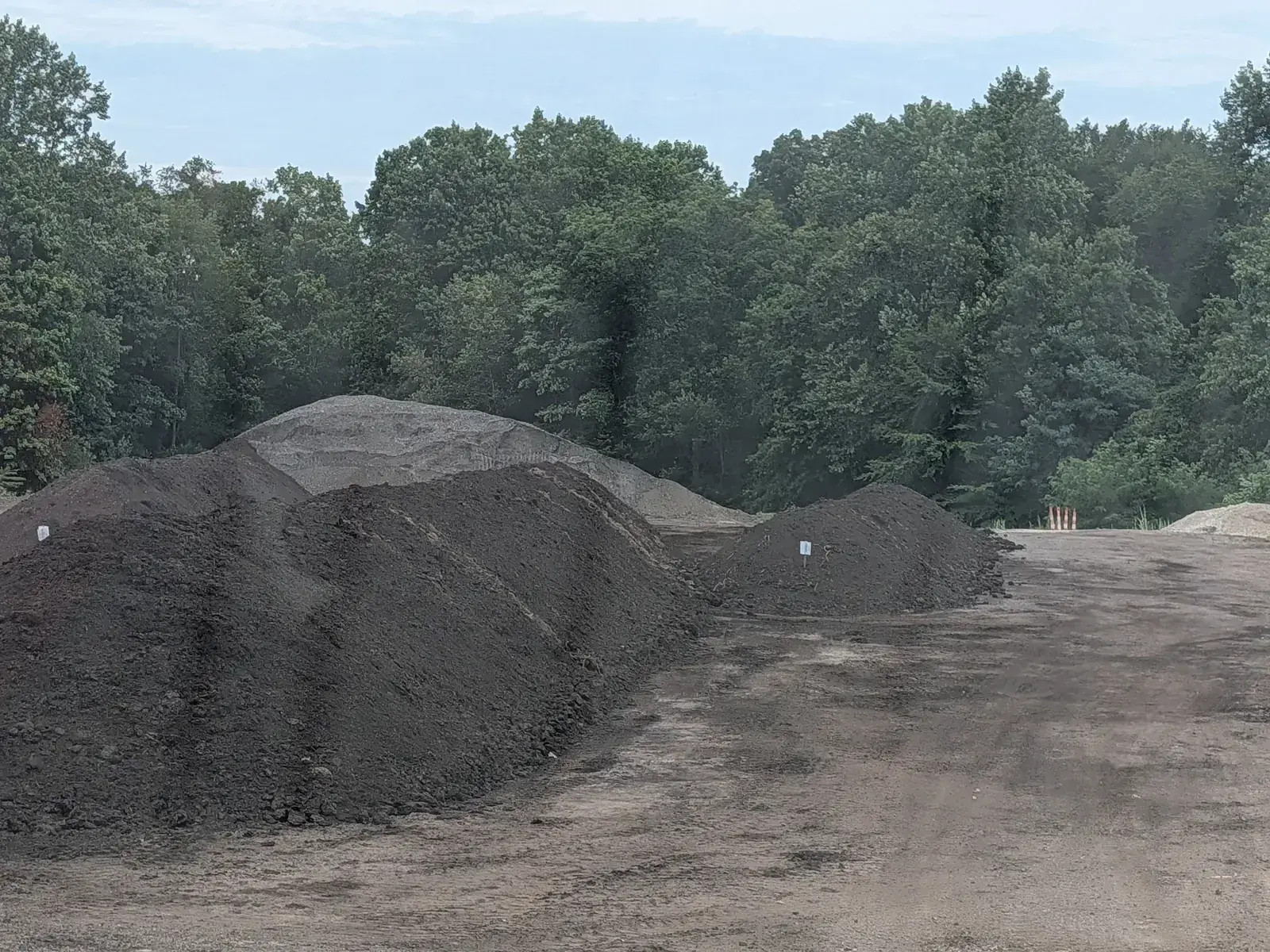
One cubic yard covers about 100 square feet at three inches deep, and almost every bulk material order can be sized from that one fact. Measure the area, decide how deep the material needs to sit, and the yardage falls out of simple arithmetic. Ordering short means a second trip. Ordering long means a pile you have to find a home for.
Here's the short version:
- One cubic yard covers about 100 square feet at three inches deep.
- Square feet times depth in inches, divided by 300, gives cubic yards.
- Depth matters more than most people expect, because doubling the depth doubles the order.
- Round up rather than down, since material settles once it is spread.
- Load limits shape the order too, so a large job may arrive across more than one load.
Start With Square Feet, Then Pick a Depth
Measure the length and width of the area in feet and multiply them. A bed that runs 20 feet long and 10 feet wide is 200 square feet. For an odd shape, break it into rectangles, work out each one, and add them together. Circles and curves do not need to be exact. A measurement that is close is enough to size a bulk load.
Depth is the part people guess at, and it is the part that moves the number most. Topdressing an existing lawn takes a thin layer. Building a new planting bed takes a deep one. Filling a low spot depends entirely on how low the spot is. Once you have square feet and a depth in inches, the math is:
square feet times depth in inches, divided by 300, equals cubic yards.
That formula is just the 100 square feet at three inches rule rearranged, so you can use any depth you like without keeping a chart on hand.
Why One Yard Goes Further Than It Sounds
A cubic yard is a cube three feet on every side, which looks like a modest pile in a driveway. Spread thin, it covers a surprising amount of ground. Spread deep, it disappears fast. The same yard that covers 300 square feet at one inch covers only 50 square feet at six inches. Deciding the depth before you order is the single most useful thing you can do.
Four Worked Examples
A New Planting Bed
You want a new bed along the side of the garage, 20 feet by 10 feet, and you want six inches of good soil in it. That is 200 square feet. Run the numbers: 200 times 6 is 1,200, divided by 300 is 4 cubic yards.
If you are building the bed on top of heavy clay, some of that volume can be leaf compost worked into the soil rather than straight topsoil. Compost is an amendment you mix in to add organic matter. Topsoil is what you build with. Many beds end up as a mix of the two.
Topdressing a Lawn
Say you are topdressing 3,000 square feet of lawn before seeding, and you want a half inch layer so the grass is not buried. That is 3,000 times 0.5, which is 1,500, divided by 300, which is 5 cubic yards.
Thin layers are the norm here. If you are chasing bumps and ruts rather than an even skim coat, the depth varies across the lawn and you are better off estimating by the low areas. The approach is laid out in this guide on how to level a bumpy lawn with screened topsoil before fall seeding, and it pairs well with bulk screened topsoil delivery since screened material spreads evenly without rocks and roots catching the rake.
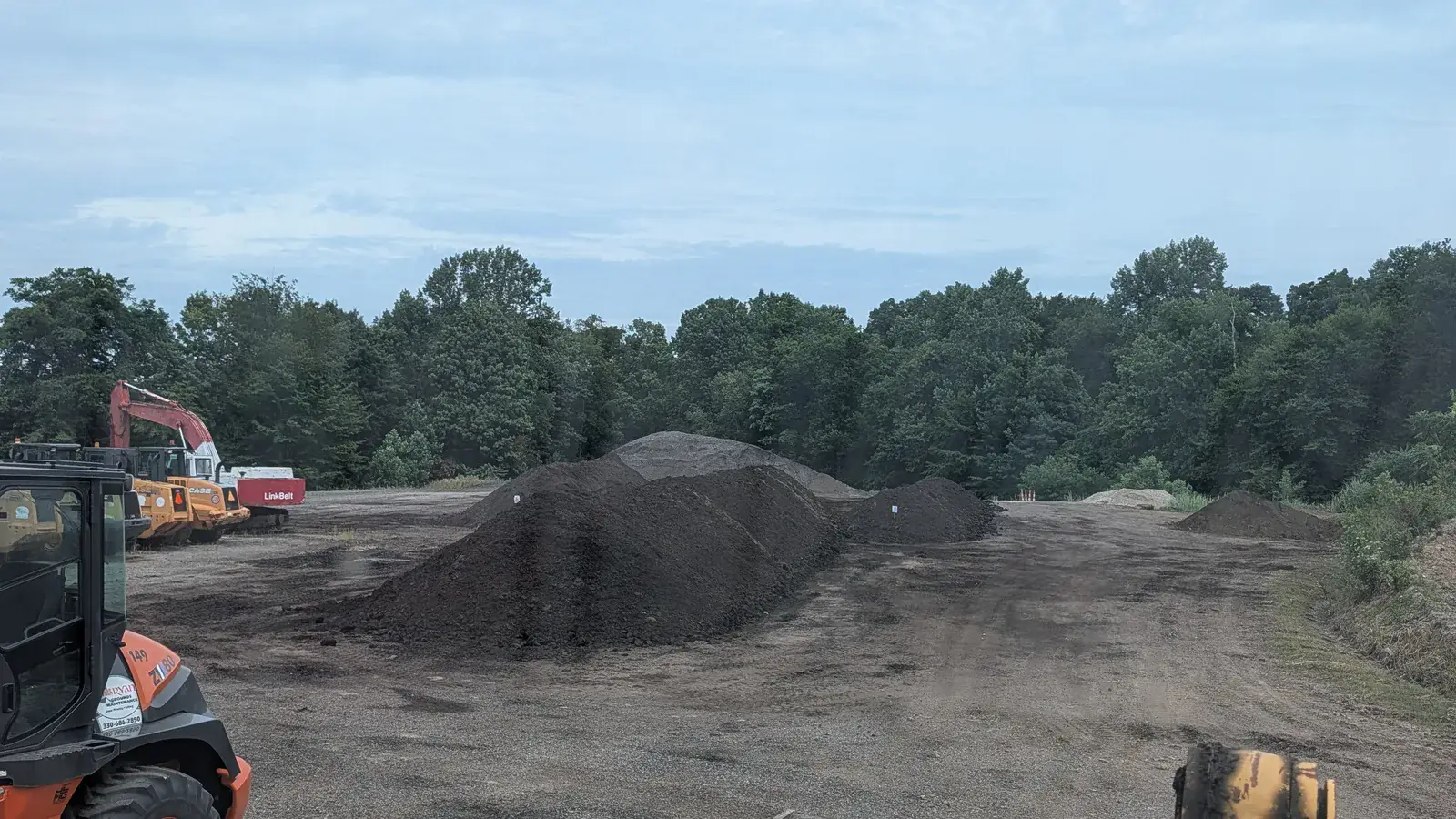
A dump truck load of screened topsoil placed at the edge of a driveway, ready to be moved by wheelbarrow.
Filling a Low Spot
Low spots are trickier because they are not a uniform depth. A dip that measures 12 feet by 8 feet might be four inches deep at the center and nothing at all at the edges. Use the average depth, not the deepest point. A reasonable average for a saucer shaped dip is roughly half the deepest measurement, so a four inch low point averages about two inches.
That gives 96 square feet times 2, which is 192, divided by 300, which is a little under one cubic yard. Round up to one yard and you have material left for the next dip you find. Most yards have more than one, and there is more on finding and correcting them in this piece on fixing low spots and yard drainage before Northeast Ohio autumn rain.
A Driveway or Lane
A driveway 100 feet long and 10 feet wide is 1,000 square feet. At three inches of surface material that is 1,000 times 3, which is 3,000, divided by 300, which is 10 cubic yards.
For a drive or a lane, asphalt millings delivery is worth a look. Millings are recycled road surface that compacts and knits together in warm weather, so they hold a firmer surface and wash out far less than loose gravel. They are best installed in the heat.
Coverage at a Glance
| Depth | Coverage per cubic yard | Typical use |
|---|---|---|
| 1/2 inch | About 600 square feet | Light lawn topdressing |
| 1 inch | About 300 square feet | Topdressing, thin fill |
| 2 inches | About 150 square feet | Shallow fill, compost layer |
| 3 inches | About 100 square feet | Driveway surface, general fill |
| 4 inches | About 75 square feet | Bed building, sod prep |
| 6 inches | About 50 square feet | Deep bed, raised bed |
| 12 inches | About 25 square feet | Deep fill, planting holes |
Two more things that affect the order. Material settles once it is spread and walked on or driven over, so a slight overage is usually the safer side to land on. And load limits matter when you get into larger numbers. Screened topsoil and asphalt millings go up to 5 yards per load. Leaf compost goes up to 8 yards per load. A 10 yard driveway job, for example, arrives across more than one load.
Sizing It With O'Bryan Grounds Maintenance
O'Bryan Grounds Maintenance has been independently owned and operated in Stow since 1993, and the material side runs out of our own yard on Seasons Road. Screened topsoil, leaf compost and asphalt millings are screened, stacked and loaded there, and delivered by the cubic yard across Stow, Cuyahoga Falls, Munroe Falls, Silver Lake, Tallmadge, Hudson, Kent, Akron, Twinsburg, Macedonia, Aurora and Streetsboro. The yard runs weekdays 9 to 5 in the warm months, roughly April through October. We are rated 4.8 stars on Google across 23 reviews.
If you would rather not do the arithmetic, tell us the dimensions and what you are trying to accomplish, and we will work out the cubic yards with you. Coverage, load sizes and drop off details are on our bulk material delivery page.
FAQs
How much topsoil do I need?
One cubic yard covers about 100 square feet at three inches deep. Measure the area in square feet, multiply by the depth in inches, then divide by 300 for the yardage. Tell us the project and we will size the load with you.
Should I round up or down?
Round up. Material settles when it is spread and compacted, and a small surplus is easy to use elsewhere in the yard. Coming up short means waiting on another load before you can finish.
How do I figure a low spot that is not a uniform depth?
Measure the deepest point, then use roughly half of that as your average depth for the calculation. A dip that is four inches at the center and tapers to nothing at the edges behaves like a two inch average. It is an estimate, not a survey, and it lands close enough for a bulk order.
What if my order is bigger than one truckload?
Larger jobs arrive across more than one load. Screened topsoil and asphalt millings go up to 5 yards per load, and leaf compost goes up to 8 yards per load. Let us know the total yardage and we will plan the loads around it.
Where does the material get dropped?
By dump truck, placed where the truck can safely reach. Delivery is made to the curb, and we do not typically drive across lawns. Past the curb we are not responsible for damage to driveways, sidewalks, homes, garages, fences, plants, vehicles or utility wires.
Need material delivered?
Tell us the material, the town and roughly how many yards, and we will size the load with you.